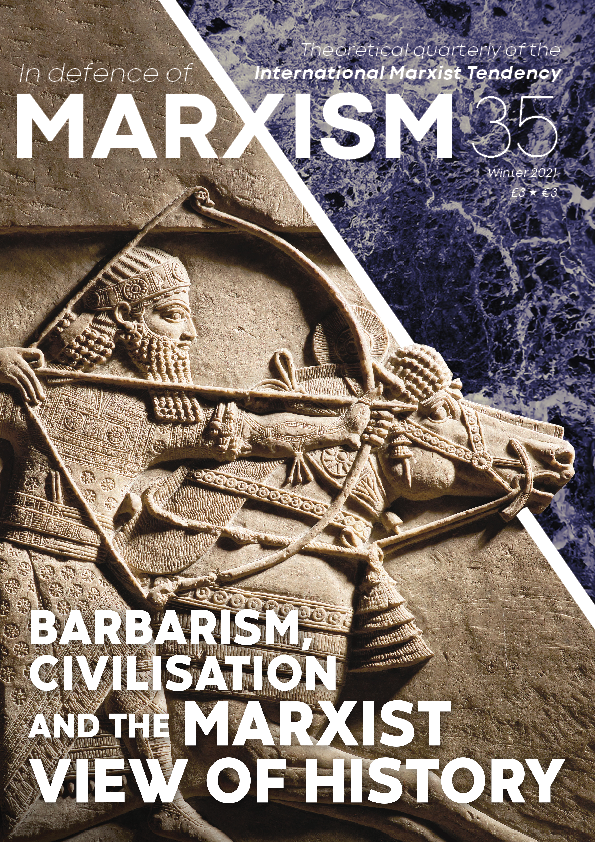
This issue takes up what has become one of the most recognised slogans of the Marxist movement: ‘socialism or barbarism’.
As the editorial notes, barbarism is not merely a future prospect; it is already spreading across large areas of the world. We explain how every mode of production has an ascending phase, which once it reaches its limits, enters into a period of decline. Yet within this decline, the seeds of a new society are developed within the old. This is precisely the situation capitalism is in ; the practical solution of which requires the building of the revolutionary party.
This process is most graphically revealed in an article by Thomas Soud on the Sudanese Revolution of 2018-21, which was one of the most powerful movements of the masses so far this century. The article explores the background to the revolution, its incredible potential, and how it was defeated – leading to the barbarism we see in the region .
We are supplementing this with an excerpt from Leon Trotsky’s article The Lessons of the Paris Commune. In it, Trotsky draws out the limitations of the leadership of the Commune, and explains the importance of a centralised revolutionary party for the victory of the socialist revolution.
The next article, by Tom Trottier, takes up the movement in the US against the Vietnam War, which mobilised millions against the government. In this context, a powerful revolutionary party could have been built to challenge the might of US imperialism from within, however this opportunity was missed by the American ‘left’ at the time. The article contains important lessons for , in the context of the Palestine solidarity movement.
Finally, we are pleased to publish a review by Daniel Morley of Thomas Mann’s ‘The Magic Mountain’. The book brilliantly encapsulates the impotence of the bourgeoisie to further take society forward, and astutely captures the decadence of a class that has outlived its historic function.
No longer shipping to the EU & North of Ireland :(
It is with regret that we had to stop any sales to the EU & North of Ireland following the implementation of the new EU GPSR export requirements on 13 Dec 2024. We are very sorry, this is as frustrating to us as it is to all our valued customers on the continent. We will keep our eyes open in case any changes to the law come in, but that seems unlikely. Please go to Wellred Books publisher's website to find EU based stores that stock Wellred titles!
To provide the best experiences, we use technologies like cookies to store and/or access device information. Consenting to these technologies will allow us to process data such as browsing behaviour or unique IDs on this site. Not consenting or withdrawing consent, may adversely affect certain features and functions.
Functional
Always active
The technical storage or access is strictly necessary for the legitimate purpose of enabling the use of a specific service explicitly requested by the subscriber or user, or for the sole purpose of carrying out the transmission of a communication over an electronic communications network.
Preferences
The technical storage or access is necessary for the legitimate purpose of storing preferences that are not requested by the subscriber or user.
Statistics
The technical storage or access that is used exclusively for statistical purposes.The technical storage or access that is used exclusively for anonymous statistical purposes. Without a subpoena, voluntary compliance on the part of your Internet Service Provider, or additional records from a third party, information stored or retrieved for this purpose alone cannot usually be used to identify you.
Marketing
The technical storage or access is required to create user profiles to send advertising, or to track the user on a website or across several websites for similar marketing purposes.