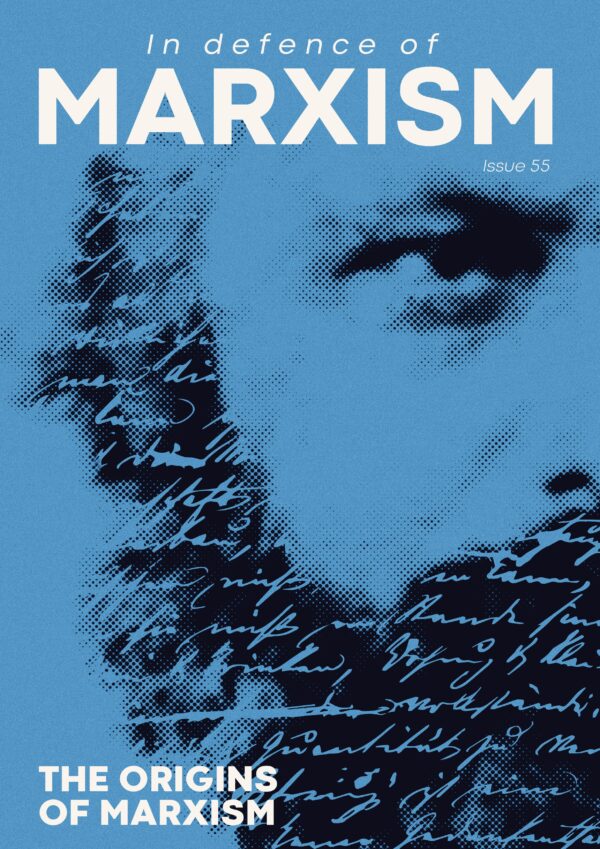
It is 180 years since Marx and Engels wrote The German Ideology; the first work where they properly develop the ideas now known to the world as ‘Marxism’. To celebrate this milestone we are publishing a special issue of the IDOM dedicated to the origins of Marxism.
The editorial starts with an exploration of ‘what makes Marxism scientific?’ Rather than simply asserting that it accords with the ‘scientific method’, it takes us on a journey to explain the development of the scientific method itself, through the course of human history. As such, it places Marxism in its proper context of the culmination of thousands of years of scientific discovery.
The lead article by Josh Holroyd and Jérôme Metellus explains the history of ‘How Marx became a Marxist’. It traces the key events and struggles in his youth, as well as the key thinkers that inspired him, all shaped his outlook to arrive at the powerful philosophy and method that we now know as Marxism.
Similarly, we have an article by Adam Booth on the origins of Marxist economics, that deals with the history of economic science, the method of Marxism, and the essential laws of capitalism that Marx uncovered. It is an excellent and accessible introduction to a topic that some comrades find daunting.
The cultural article by Julien Arseneau takes up Nikolai Chernyshevsky and his novel ‘What is to be Done?’ He explores the history of the revolutionary intelligentsia in nineteenth-century Russia, and how, for a time, different political ideas and debates were expressed through literature. He uncovers how Chernyshevsky’s novel was to impact subsequent generations of revolutionaries, and its links to the Russian Revolution of 1917.
Finally, Daniel Morley reviews the book ‘Who Paid the Pipers of Western Marxism?’, which explores the close links between the US state and the so-called ‘Marxist’ intellectuals of the Frankfurt School. Daniel looks deeper into the petty-bourgeois nature of such academics to help explain their reactionary ideas.